

🌍
ABOUT US: A Brief History of Esyantra and Powerstore
Esyantra Australia was founded approximately seven years ago at the behest of Dr. Vijay Maddali. The core concept behind our technology dates back to the 1960s and is based on the phase-change properties of silicon. While pure silicon is rare in nature, silicon dioxide is incredibly abundant—commonly found in quartz and common sand. Pure silicon requires an extraordinary amount of energy to melt, a process that occurs at a precise, fixed temperature. This makes it unparalleled as a medium for storing thermal energy.
While the science was sound, practical application had been stalled for over 50 years due to a major engineering hurdle: finding a container, or crucible, that could withstand these extreme conditions.
Dr. Maddali spent two years researching and developing a solution to this problem. After purchasing a specialized furnace, Garth Davey and team spent another year engineering and testing various crucibles. Finally, we successfully produced a crucible capable of holding molten silicon through multiple heating and cooling iterations over several months.
With the containment problem solved, full-scale design work began. It quickly became apparent that gas could not provide enough surface area for efficient two-way energy transmission. Instead, the energy had to be carried by a fluid at 1420°C. The team selected liquid aluminium as the heat transfer fluid. Fortunately, our proprietary crucible could withstand both metals, though managing two distinct molten materials significantly increased the engineering complexity.
Ultimately, the team finalized a design for a commercial unit housed within a twenty-foot shipping container, boasting a storage capacity of 600 kWh. While highly complex, this system represented a massive technological breakthrough—achieving what no other company had managed in the past half-century.
Prototype Development & Technological Evolution
Manufacturing the initial prototype in India was a strategic decision. Labor costs were significantly more economical compared to Australian rates, and Dr. Maddali maintained a strong network of professional connections in India, despite having lived in Australia for over twenty years.
Phase 1: Molten Silicon & Aluminum R&D Our early foundational engineering successfully demonstrated the containment of high-temperature phase-change materials, including molten silicon at 1,420°C and liquid aluminum loops. While this validated our crucible containment intellectual property, the practical challenges of managing liquid metal seals led our engineering team to evolve the platform into a safer, solid-state commercial architecture.
Phase 2 & 3: Solid-State Iron Matrix & Turbine Integration Following this initial phase, we engineered a solid-state iron matrix storage system housed inside a 20-foot shipping container footprint with a 600-kWh capacity. Operating safely at zero pressure up to 1,000°C, this design eliminated internal moving parts and liquid seal risks entirely.
- Prototype 2 proved rapid thermal storage and controlled steam discharge.
- Prototype 3 integrated closed-loop turbomachinery to generate electricity directly from stored heat.
Both Prototype 2 and Prototype 3 were independently witnessed and verified during live operational runs by research faculty from a leading Indian university. Today, Powerstore International Investments leads the design engineering and commercial deployment of this solid-state thermal energy storage architecture globally.
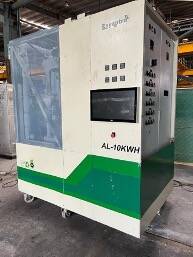
Continuous internal improvements led to the construction of a third and final prototype, which successfully outperformed its predecessor. This unit stored heat, precisely controlled both input and output functions, and drove a small steam turbine. It became our first system capable of tri-mode output:
- Heat as a gas
- Steam under pressure
- Electrical power
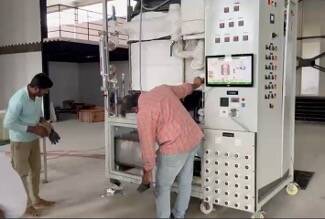
(Below is a photograph of this unit being constructed under the strict supervision of Dr. Vijay Maddali.)
Market Validation & Strategic Pivot
We have proudly demonstrated this advanced unit to key potential users. This includes two of the largest data centre operators in Asia and three Divisional Area Commanders from the Indian Army. Following these demonstrations, both entities issued formal Letters of Intent (LOIs).
The operational requirements for these units involve extreme conditions, including helicopter deployment, rough terrain, poor road infrastructure, and disaster-relief environments. This feedback caused us to strategically rethink our approach. While our previous units were capable of maintaining high discharge temperatures of 900°C for extended periods, our target operators consistently indicated they did not require temperatures that high.
- The Indian Army primarily requires steam for cooking and heating in high-altitude Himalayan operational zones.
- The Data Centres require absorption chillers to reduce their electrical input by 25% to 30%.
With this immense accumulation of field data and operational knowledge, the prototyping phase was officially complete. The clear next step was the immediate assembly of a pre-production unit.
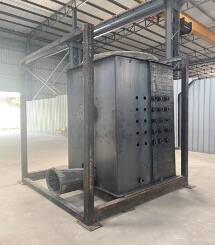
ABOVE Here is the pre-production unit at its most basic level, it has yet to have its control panel and electrics, as well as its full enclosure
Once finalized, this pre-production unit will be evaluated by the authors of our LOIs, who are eager to witness its versatile heat storage and customized distribution capabilities firsthand. Additionally, third-party devices can be utilized for heat-to-electricity conversion under a reciprocal perpetual licensing agreement.
Corporate Restructuring & Investment Opportunity
Our original intention was to manufacture these units in Australia; however, the local Research & Development authority proved exceptionally difficult to navigate. Despite undergoing three separate audits and a successful furnace demonstration, the department insisted on an independent audit, pledging to accept the referee's findings. Although the independent audit fully vindicated Esyantra, the governing authorities chose to ignore the findings—neither rejecting the concept outright nor approving it, effectively stalling progress. In our assessment, local administrative frameworks do not adequately support domestic manufacturing, which ultimately solidified our decision to build in India.
In parallel, the Esyantra Board determined that Singapore is the natural home for the company’s global headquarters. Singapore serves as the primary business and financial hub for Southeast Asia, ensuring seamless, fluid currency transactions. Conversely, moving capital out of India involves significant regulatory hurdles that delay vital business operations.
To seamlessly accommodate Australian investors, the corporate framework utilizes Powerstore Australia as a dedicated Special Purpose Vehicle (SPV), ensuring a compliant and efficient investment pathway.
The capital raised from this share sale will achieve two critical objectives:
- Fund ongoing innovation to ensure our technology consistently leads the market through subsequent generations (e.g., Mark 1, Mark 2, and beyond).
- Retire foundational debt accrued over seven years of unpaid design and development work.
- Head Office: Singapore
- Manufacturing: India
- Investment SPV: Powerstore Australia